FIFA World Cup 2026 — Groups, Fixtures and Top Scorers
The biggest tournament in football history. 48 teams, 12 groups, hosted by the United States, Canada and Mexico from June 11 to July 19, 2026. Full coverage here.
Loading groups...
Loading fixtures...
Loading top scorers...
Frequently Asked Questions
Everything you need to know about the 2026 FIFA World Cup.
The 2026 FIFA World Cup starts on June 11, 2026 with the opening match between Mexico and South Africa at the Estadio Azteca in Mexico City. The tournament runs through to the final on July 19, 2026 at MetLife Stadium in East Rutherford, New Jersey.
The 2026 World Cup is the first ever 48-team edition of the tournament, expanded from the previous 32-team format used since 1998. The 48 nations are divided into 12 groups of 4 teams each, with the top 2 from each group plus the 8 best third-placed nations qualifying for the round of 32.
The 2026 World Cup is co-hosted by three nations — the United States, Canada and Mexico. This is the first ever three-nation World Cup. There are 16 host cities in total: eleven in the United States, three in Mexico and two in Canada. Each host nation qualified automatically.
The 48 teams play a group stage of 3 matches each across 12 groups. The top 2 from each group plus the 8 best third-placed nations advance to the round of 32 — 32 teams in total. From there it is single-leg knockout football: round of 32, round of 16, quarter-finals, semi-finals, third-place play-off, and final.
The final of the 2026 FIFA World Cup will be played at MetLife Stadium in East Rutherford, New Jersey, USA, on July 19, 2026. The opening match is at the Estadio Azteca in Mexico City on June 11, 2026.
Argentina enter the tournament as defending champions after their 2022 triumph in Qatar. France, Brazil, Spain, England and Germany are all considered serious title contenders, with the Netherlands, Portugal and Italy in the next tier of contenders. Host nation Mexico will hope to leverage home support in their group stage matches.
Group standings refresh every six hours, fixtures every hour, and the top scorer chart every six hours. The data is sourced from a structured football data feed and reflects the most recently confirmed picture of the tournament. During the tournament itself the data will move live with each completed match.
The 2026 FIFA World Cup — The Biggest Tournament in Football History
This is going to be different. The 2026 World Cup is the first ever 48-team edition, the first ever co-hosted by three nations, and the biggest single sporting event the world has ever staged. From the opening match at the Estadio Azteca to the final at MetLife Stadium in New Jersey, this is a summer that football will remember.
You can feel when a tournament is carrying real weight before the football even settles, and this one is loaded with it. Forty-eight nations, twelve groups, sixteen host cities across the United States, Canada and Mexico. On this page I track the full World Cup as it unfolds — groups, fixtures, results and top scorers, updated regularly across the tournament.
The New 48-Team Format
For the first time, the World Cup expands from 32 teams to 48. The expanded format means twelve groups of four nations each, and a much longer knockout bracket than the World Cup has ever known. The eight previous World Cup tournaments since 1998 ran with 32 teams in eight groups of four, and that structure is now in the rear-view mirror.
In games with this kind of competitive pressure, the early matches matter even more than before. The top two from each group qualify directly for the round of 32, while the eight best third-placed teams also advance. That means thirty-two of the forty-eight nations move on into the knockout rounds, but losing two of three group matches still ends most tournaments early. Every result counts.
The Three Host Nations
The 2026 World Cup is co-hosted by the United States, Canada and Mexico — the first ever three-nation World Cup. Sixteen host cities are involved: eleven in the United States, three in Mexico and two in Canada. The opening match is staged at the historic Estadio Azteca in Mexico City. The final will be played at MetLife Stadium in East Rutherford, New Jersey, on July 19, 2026.
Each host nation qualified automatically, joining the field as Group A (Mexico), Group B (Canada) and Group D (United States). Fixtures like these — host nation openers, marquee group-stage matchups, last-sixteen ties decided on a single afternoon — always carry more pressure than the table suggests. The atmosphere across sixteen host cities is going to be unlike anything the World Cup has produced before.
Group Stage Structure
Twelve groups of four nations play three group stage matches each — a total of 72 matches before the knockout rounds even begin. The group stage runs from June 11 to June 27, with matches across all sixteen host cities and several kicking off at prime-time in multiple regions worldwide.
The top two from each group qualify directly for the round of 32. The eight best third-placed nations across the twelve groups also advance, giving second-chance hope to teams that lose a tight group opener. That structure has been borrowed from the Euros and is being scaled up to its full World Cup form for the first time.
The Knockout Bracket
From the round of 32 onwards, the tournament becomes single-leg knockout football all the way to the final. Round of 32, round of 16, quarter-finals, semi-finals, third place play-off, and final — every match a one-off, every match decided on the day, every match capable of producing the football moments that get remembered for generations.
The knockout bracket runs from June 29 through July 19. Forty matches, decided on the pitch in 90 minutes plus extra time and penalties if needed. The tournament wraps up with the final at MetLife Stadium in New Jersey on the evening of July 19, 2026.
The Title Race
Every World Cup has its favourites, and 2026 is no different. Argentina arrive as defending champions after their 2022 triumph in Qatar. France, Brazil, Spain, England and Germany all enter with realistic title hopes. The Netherlands, Portugal and Italy sit in the next tier. Host nation Mexico will hope to ride home support across the opening matches.
From a fan perspective, the unpredictability is what makes the World Cup. Argentina were not the obvious favourites going into Qatar 2022 and still walked away with the trophy. France lost their opening match in 2002 and crashed out in the group stage. Greece won Euro 2004 against the run of every prediction. The World Cup respects no reputations once the football begins — and in this expanded 48-team field, there is more room than ever for surprises.
The Top Scorer Race
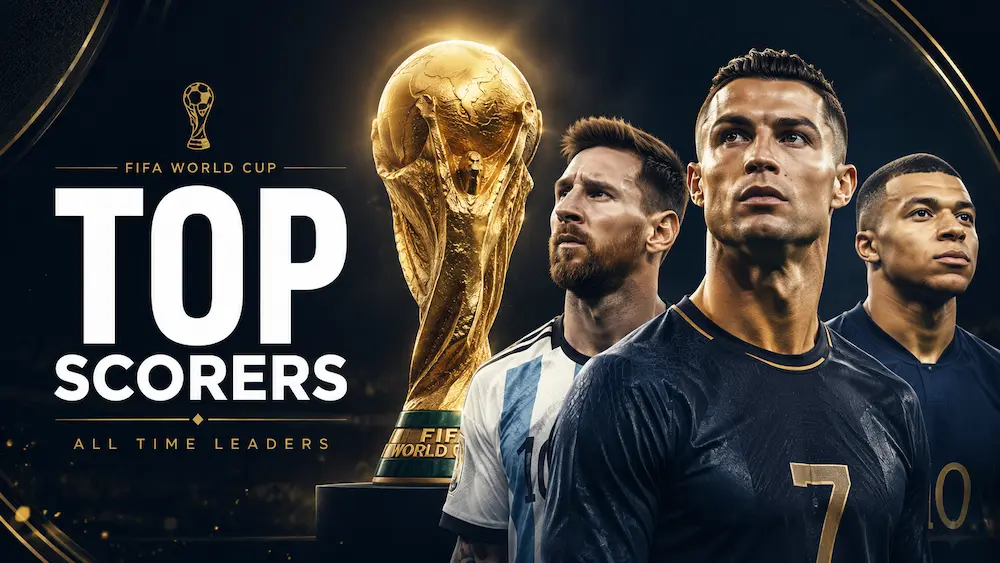
The Golden Boot at the World Cup is one of the most coveted individual awards in football. Past winners include Gerd Müller, Mario Kempes, Paolo Rossi, Gary Lineker, Salvatore Schillaci, Davor Šuker, Ronaldo, James Rodríguez, Harry Kane, Kylian Mbappé. The list reads like a roll call of generational forwards from across football history.
The top scorer table on this page will update across the tournament as goals are scored. With 48 teams and over 100 matches, this is the first edition of the World Cup where strikers have a genuinely extended platform to accumulate goals before the knockout rounds. The competition for the Golden Boot is likely to be one of the most open the World Cup has ever produced.
What to Expect From This Tournament
Big tournaments build their own momentum. Group stage upsets shake the bracket. A single missed penalty in a round-of-16 tie can decide a campaign. Squad depth, injury management and tournament fatigue across a longer expanded format will all matter more in 2026 than they did in any previous World Cup edition.
Fixtures like this are why football has its global audience. The World Cup is the one event that pulls casual viewers, lifelong fans and entire nations together for six weeks of football across a summer. From the Estadio Azteca opener to the MetLife final, this tournament is going to write the next chapter in World Cup history — and the page you are reading right now will track every step of it.
Tracking the World Cup This Summer
Whatever your relationship with the tournament — whether you support one of the 48 nations involved, follow international football across the calendar, or simply tune in for the matches that everyone is watching — this page is designed to give you everything you need in one place. Groups, fixtures, results, top scorers, all updated regularly across the tournament.
Bookmark the page, check it each matchday, and use it to follow the tournament from the opening night on June 11 through to the final on July 19. The 2026 World Cup is the biggest football event ever staged, and the table on this page tells the story as it happens.
I write football the way fans actually feel it, because rivalry, atmosphere, and big-match pressure often reveal things that pure numbers do not.